
Fallingwater Restoration
A bit of an update

In July 2025, we wrote about Fallingwater, the legendary masterpiece by Frank Lloyd Wright. That post drew heavily on personal impressions from visits to the site. Now, with a multi-million-dollar restoration project reportedly completed after three years, it feels like the right moment to take another look at this iconic work of architecture. Let’s intersperse a few parts of the original post with news on the restoration:
Previously posted:
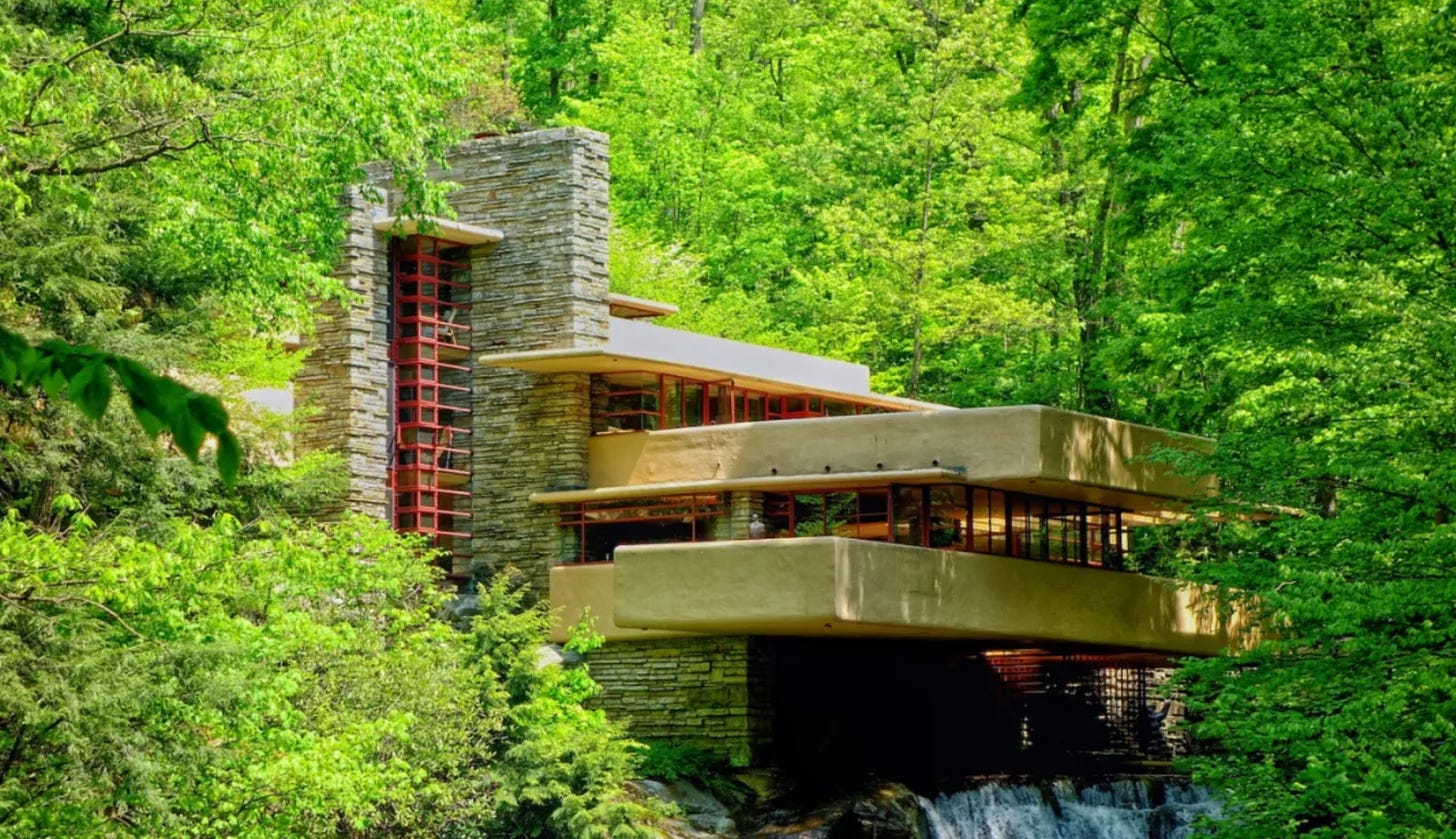
Fallingwater is arguably Frank Lloyd Wright's most famous work. So many words have already been written about it that I am loath to post about it at all. On the other hand, how can a series about architecture leave Fallingwater out? That said, I lived very close by for a short period and made two visits. Architecture for the Soul—Fallingwater will contain a liberal dose of personal observations.
Update from fallingwater.org:
Preserving Fallingwater has been ongoing almost since its completion. From daily maintenance and housekeeping tasks to larger efforts to protect the house, the care of Frank Lloyd Wright’s masterpiece is paramount to the Western Pennsylvania Conservancy as it continues the important practice of monitoring and preserving Fallingwater for future generations.
Previously posted:
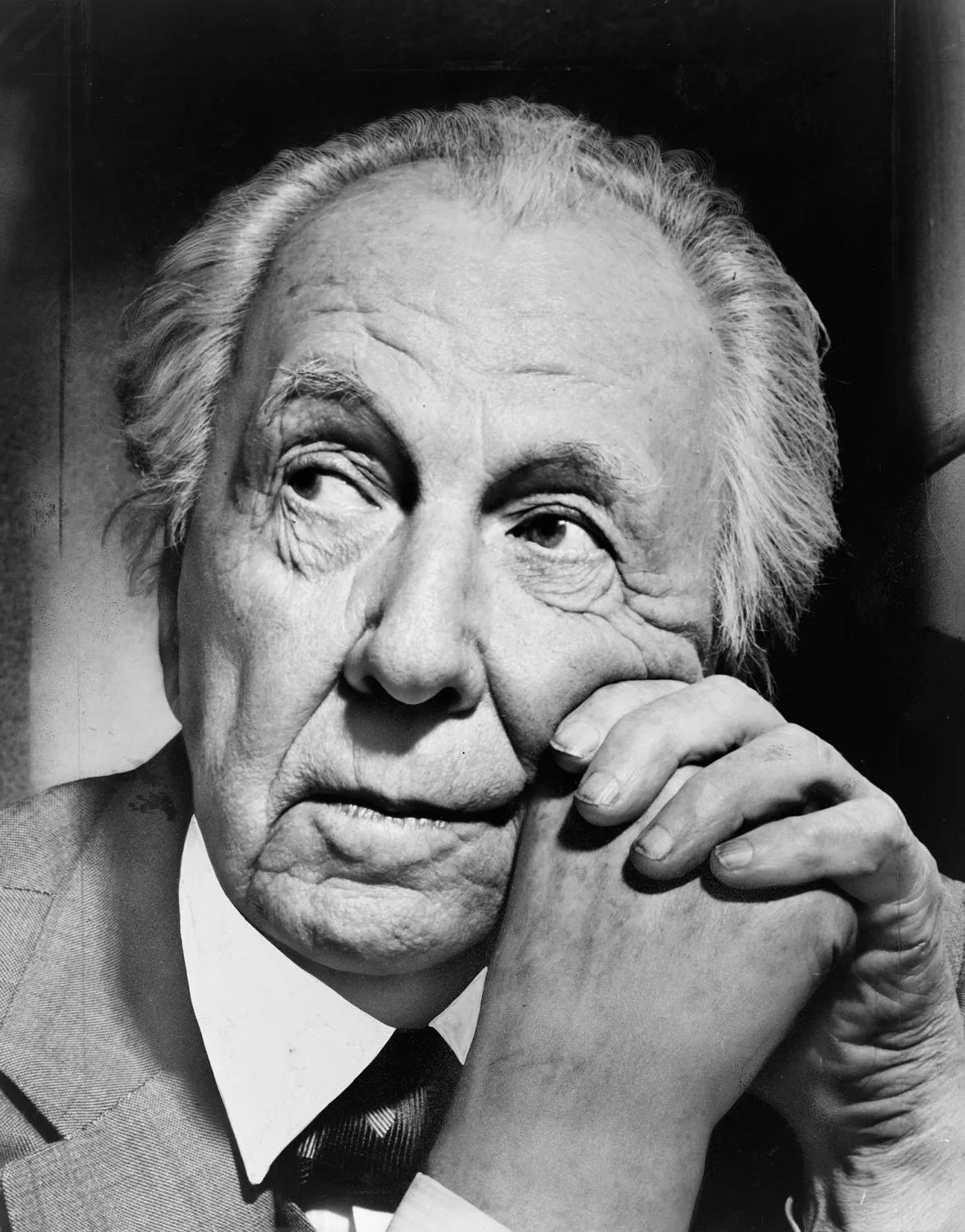
Frank Lloyd Wright was born on June 8, 1867, in Richland Center, Wisconsin. He attended the University of Wisconsin-Madison in 1885–86, where, in the absence of instruction in architecture, he took engineering courses. But greater things awaited him, and he departed in 1887 for the architectural Mecca of Chicago. There, he eventually became an assistant to the great Louis Sullivan. Thus began a career based on his concepts of “organic architecture,” promoting a rational harmony between the built environment and nature, leading him inexorably toward Fallingwater.
Update from Architectural Digest:
Arguably, his [Wright’s] most famous design, the singularity of the home has meant it comes with equally unique challenges. Among the most pivotal, its integration into the natural site has made it particularly vulnerable to the elements.
Previously posted:
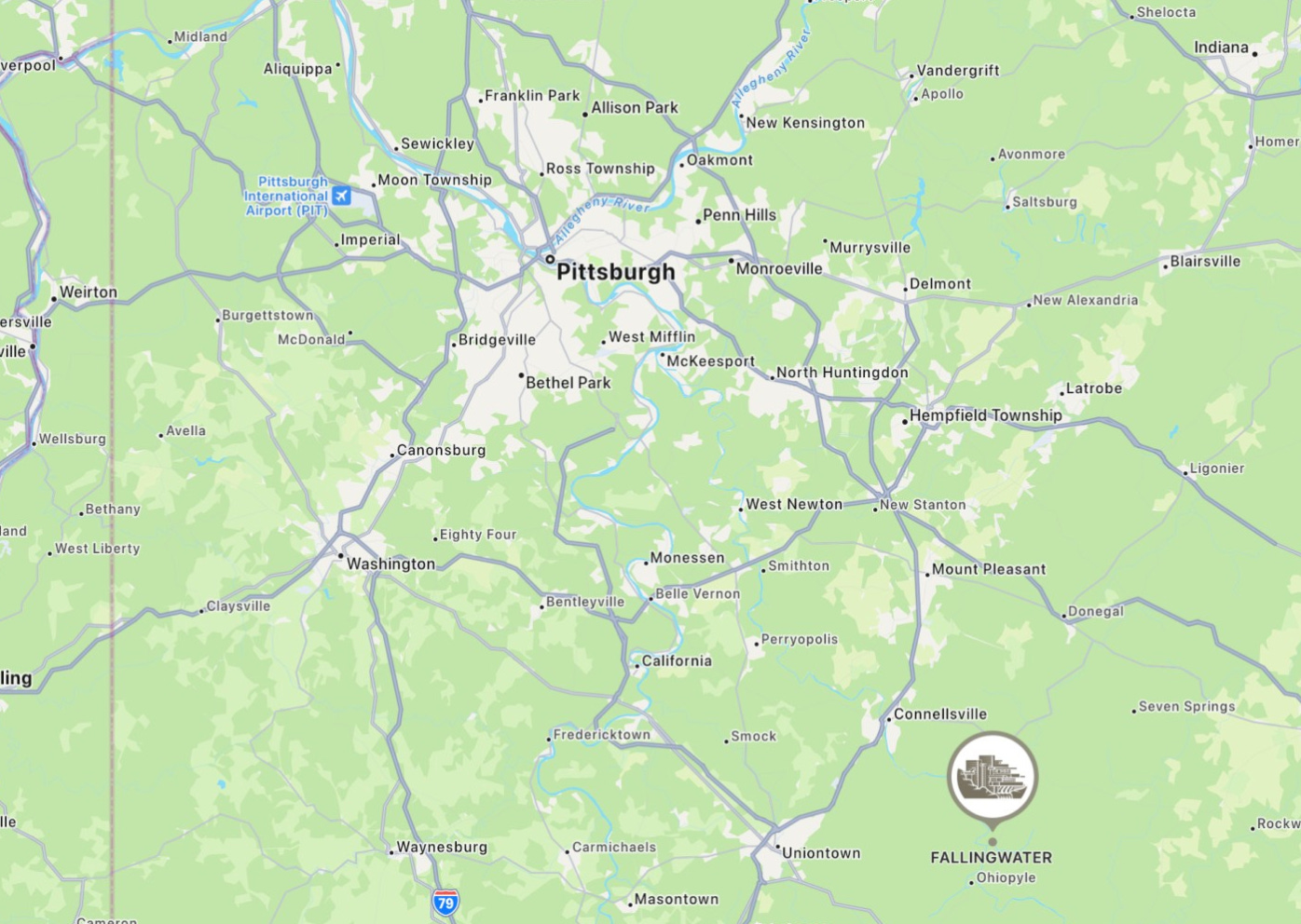
Mr. Wright designed this residence for Edgar Kaufmann, Sr., and his family in 1935. The Kaufmanns were well known for their department store chain, of the same name. The site is about an hour southeast of Pittsburgh, as you can see on the map below, and was intended to be a weekend home that the Kaufmanns could access quickly from The ‘Burgh. Here is the first personal aside: when I was a young man, I was told I needed to “build up my credit.” Since I lived in Western Pennsylvania, you guessed it, my first credit card was from Kaufmann’s Department Store!
Update from John Niland in Dezeen:
Located in Mill Run, Pennsylvania, Fallingwater’s well-known flaws included recurring leaks, material degradation, failures in the building envelope, and moisture-sensitive original interior finishes. “One of the biggest challenges was Wright’s decision not to install through-wall flashing,” Architectural Preservation Studio president Pamela Jerome told Dezeen. “Another issue was Wright’s use of river pebbles instead of broken stone for concrete aggregate.”
Previously posted:
Both [my personal] visits [to this site] were in the late ’70s, before I had any professional connection to architects or architecture. It was supposed to be a cool place to go. So, off we went. Once was certainly in the fall, and the other was probably in the spring, and each had a seasonal uniqueness. The staff folks were amazingly knowledgeable. Their passion for the subject matter blazed through. They taught us “cantilever.” It is one thing to hear about cantilevering and another to experience it at Fallingwater. I felt damp. The proximity of the water was slightly disorienting but still pleasant. To a person who had spent fifteen years in suburban ranch houses, it seemed less like a place where people had once lived and more like a museum where people should have lived. Well, enough of this.
An earlier round of major repairs had already tackled some of the building’s problems. That effort, which began in the late 1990s and continued into the early 2000s, centered on concrete restoration and—crucially—reinforcing the cantilevers.
The most recent, more comprehensive restoration went further, adding major waterproofing upgrades, continuing structural and concrete repairs, restoring the stonework, and upgrading the windows and doors.
After the death of his parents in 1963, Edgar Kaufmann, Jr., donated Fallingwater and over 400 surrounding acres to the Western Pennsylvania Conservancy, saying goodbye to what had been a part of his life for almost thirty years.
In the end, while Wright’s genius is undeniable, it’s also fair to wonder whether the home’s practical shortcomings would have been as acceptable had it been used as a full-time residence rather than a weekend retreat.